
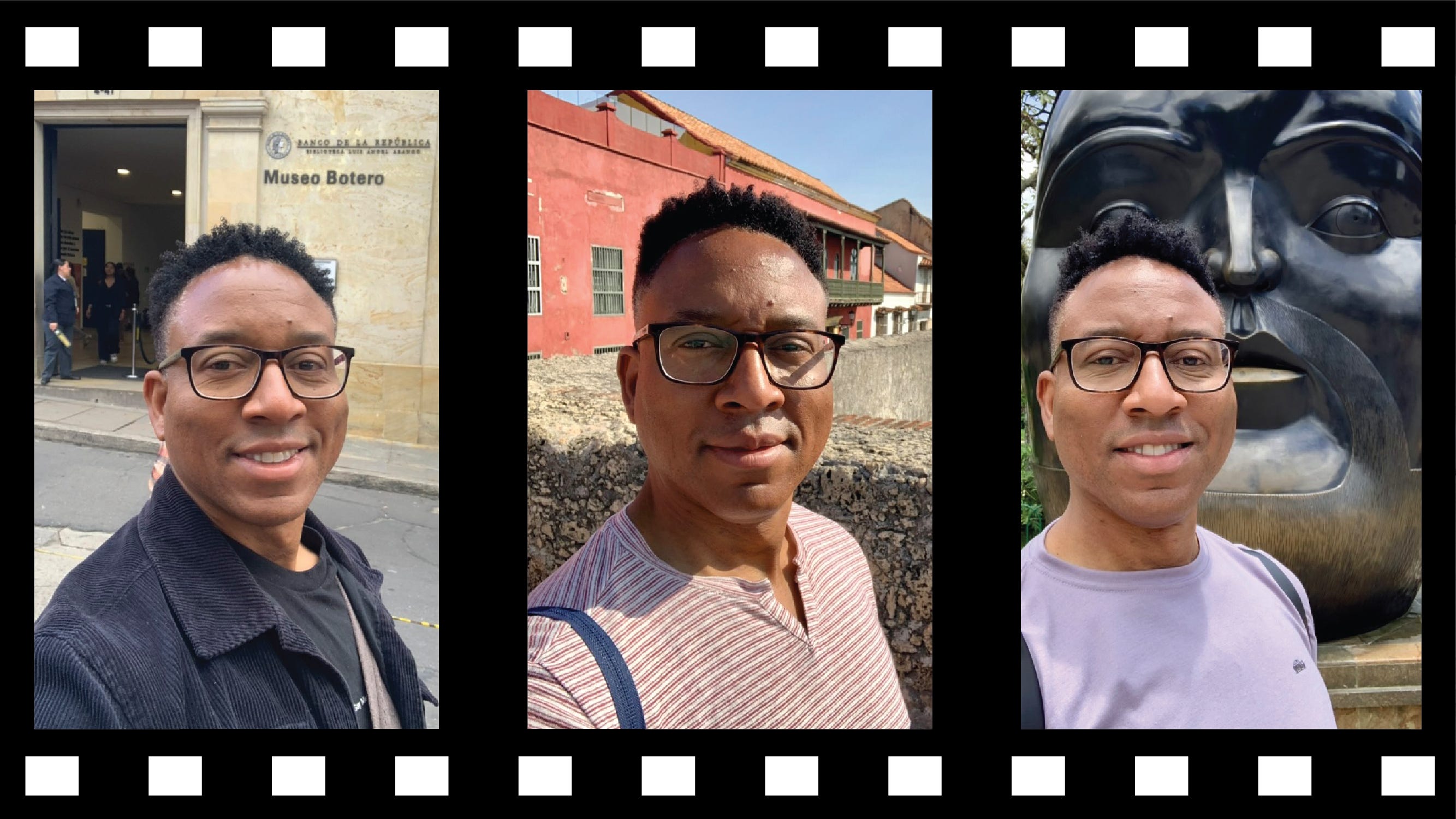
Who is this person, this Black gay American who dares to travel the world in search of himself? It’s a question I ask myself from time to time because it reminds me of the conscious deprogramming I have to do in order not to be shackled by the anti-blackness that can infiltrate my daily living and my psyche. Regardless of where I’m at in the world, the threat of it is there.
We come from hardworking country folk who came to Arizona from a small town in Oklahoma.
The question of who I am bubbled back to the surface recently when I visited the Museum of Antioquia in Medellín, Colombia. Since visiting Museo Botero during my three-week visit to Bogotá, Colombian artist and sculptor Fernando Botero’s sculptures and paintings have become some of my favourites. So I looked forward to seeing more of his creations in the city of his birth.
What I didn’t expect to be so glaring was the lack of Colombia’s Afro-descendants in the museum’s exhibition rooms. But when I realised I was leading with my Americanism, I conceded that what I was experiencing in Medellín was not dissimilar to what I’ve encountered in art galleries in Canada, the United States, and South Africa. Three countries that were former British colonies. Like England did in North America, Spain invaded much of South America, enacting genocide of the continent’s Indigenous populations and participating in the 400 years of the transatlantic slave trade. Propaganda, erasure, and suppression of Black history are also woven throughout Latin America.
The omissions may have also been more glaring, as I was the only Black visitor admiring the works. And on the way to the museum, the taxi driver made a point of driving through part of El Centro, Medellín’s downtown area, where I saw that many of the city’s poor and homeless people were darker-hued. It was like seeing neighbourhoods in California’s Los Angeles and San Francisco, and my hometown of Phoenix, Arizona. Where are their histories?
My awareness of these exclusions was further exacerbated by watching the 1994 Australian gay film, The Sum of Us. The movie stars Russell Crowe, who plays a gay man living with his father. The title and the plot got me thinking, “Who am I as a Black queer man if I rarely see myself in art and media?” Do I exist if my culture and my history are rarely seen?”
I came of age when television shows like The Jeffersons, The Cosby Show, and 227 were on the air. They were standouts for me because at their core, they embodied the values of the Black American family. The characters in these series looked like me, and I was proud of it. I didn’t grow up with money. However, as my aunt once said, “We come from hardworking country folk who came to Arizona from a small town in Oklahoma.”
Accepting myself as a gay man took more time to embrace. I didn’t come out until the late 1990s, and was grateful when I saw films like Patrik-Ian Polk’s Punks (2000), Maurice Jamal’s Dirty Laundry (2006), and Deondray Gossett and Quincy LeNear’s series The DL Chronicles (2007). Viewing queer Black characters on large and small screens encouraged me to see the beauty I possessed inside and out.
Knowing the sum of who I am is a journey, one where I learn Black queer history while excavating to uncover more of my story.
With the launch of Netflix’s streaming service in 2007 and the others that followed, there was suddenly more LGBTQ+ media to choose from. And I viewed a lot of it. But there was this tickling in the back of my brain that kept wondering, “Why am I not seeing more content featuring Black queer protagonists or romance films with Black queer couples?”
I knew it wasn’t because there is a lack of talent to create and spearhead these types of projects. Throughout my years of living in Los Angeles, I’d come across a few Black LGBTQ+ creatives who were ready to share their work. For me, the answer turned to the gatekeepers. Could it be that this scarcity of Black queer content was due to both racism and homophobia?
Since launching Our Black Gay Diaspora Podcast in 2021, a biweekly platform where I interview Black LGBTQ+ professionals who share about who they are in their countries and professions, I’ve been reminded that the practice of excluding or erasing Black queer content and history is not new. However, despite their lack of exposure in LGBTQ+ and Black media, there have been Black queer tastemakers and visionaries today and in the past who have risen to acclaim.
These include Americans Zora Neale Hurston, James Baldwin, Audre Lorde, Bayard Rustin, Joseph Beam, Barbara Jordan, Emil Wilbekin, Lena Waithe, Rayceen Pendarvis, and Niki Lopez. From the UK, notable figures include Rotimi Fani Kayode, Linda Bellos, Isaac Julien, Lady Phyll, Ajamu X, Valerie Mason-John, Topher Campbell, and Gamal ‘G’ Turawa.
Some of today’s contemporaries are South Africa’s Aurora Krotoa Moses, Kaecy, Zanele Muholi, and Nakhane, Eric Gyamfi in Ghana, Kenya’s Ruele Okeyo, George Kachimanga in Malawi, and Nigeria’s Chiamaka Okike. In Europe, there is Ireland’s Diana Bamimeke, Stefano Duc in Italy, Sweden’s Alle Eriksson, and Anthony Vincent in France.
Knowing the sum of who I am is a journey, one where I learn Black queer history while excavating to uncover more of my story. It’s scary to acknowledge publicly that I am a Black gay man from Arizona. One who grew up with an often emotionally distant mother and a sometimes abusive stepfather. I’m a man who didn’t come out until I was twenty-eight, and didn’t meet my father until I was thirty-four. Finding out after my mother died that he’d never been told about me.
My father’s unconditional love and acceptance of me as I am have been added to the foundation my mother built. One that encouraged me to never deny myself based on another’s lowered expectation of who I’m perceived to be. Which is why I’m able to travel the world in search of my answers for the moment, the day, and for a lifetime.