
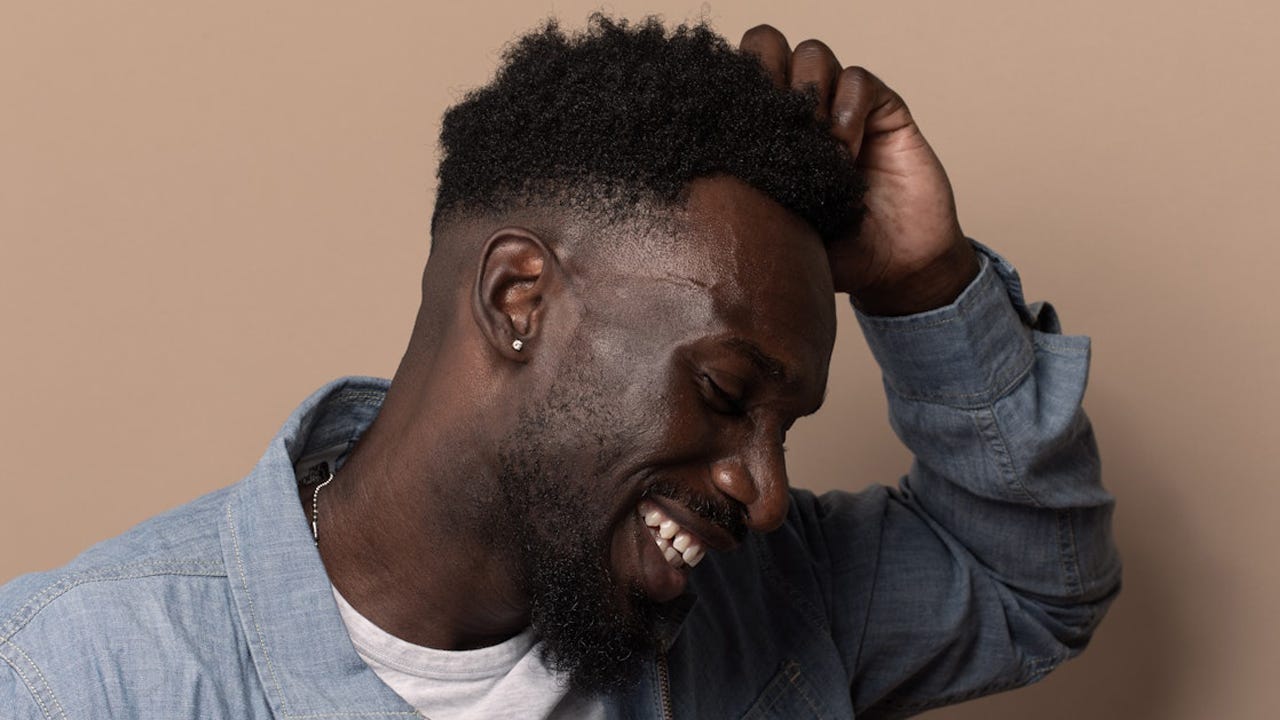
During a visit to Cartagena, Colombia, my friends and I shared how we find ways to love ourselves as queer men of color. They’re two cinnamon-colored Latino men, and I’m a caramel-tinted Black American. I opened up about how I combat anti-blackness by embracing my hair.
I became aware that my hair was not the preferred texture at seven years old. My brother was an 18-month-old plump toddler with fluffy loose curls. While combing my hair one morning, our mother made an innocuous comment that created a fissure in our fraternal bond.
“Erick, I wish you had good hair like your brother.”
Suddenly, the hair that sprouted out of my scalp like the Afro I wanted to grow as big as Michael Jackson’s became something to dislike. Thankfully, my visiting aunt said from across the room, “Don’t say that! All hair that is washed and taken care of is good hair.”
I had to reinforce the armor that shields me from self-doubt around my physical appearance.
But it was too late. There was a crack in the structure. Streams of doubt oozed into my young psyche. I no longer liked what I saw in the mirror. Although I continued to admire Michael Jackson’s bouncy mane, I no longer liked mine.
Cartagena was an interesting city to have this sort of conversation. After three weeks in Bogotá, Colombia’s capital, it was the first time I was around individuals en masse who looked similar to me.
I found myself needing to resist comparing myself to Colombia’s Afro descendants. Those with various hues of black, brown and tan, and hair longer, curlier, and looser than mine. Once more, I was navigating the minefield of internalized anti-blackness that whispered to me that my hair would never permit others to look beyond the world’s perceptions of my African origins. I had to reinforce the armor that shields me from self-doubt around my physical appearance.
My perception as a Black American in Cartagena brought me face-to-face with Colombia’s complicated relationship with its Afro descendants. Similar to my connection to my home country, I was aware that many who looked like me didn’t have access to the finer things in life. Those who served didn’t seem to fully enjoy what socio-political systems make easier to access for Colombian citizens with European phenotypes.
I may have been hyperaware of all this because it was in Cartagena where I could not ignore being watched and sometimes followed when I dined or shopped. Like my experience as an American citizen in the United States, I pretended not to see what was ever present in my peripheral vision. Which meant being cognizant of the emotional violence being heaped upon what is always fermenting from what I receive from my fellow U.S. compatriots.
Standing with my friends and watching a person only make eye contact with them didn’t feel good. Now I concede that I’m not fluent in Spanish. However, I do know that the art of good communication includes ensuring that all who are present are welcomed.
For the first time, what I learned to embrace as attractive as a Black citizen included my hair.
In 2015, after years of having a nearly bald fade, I started growing my hair. Initially, it was the result of my barber being unavailable to honor my biweekly touch-ups. During that time, I complimented a colleague on her natural curls. Several months before, she decided to forego her long, relaxed hair to discover what nature had gifted her.
“Your hair also looks like this,” she said. “All you have to do is style it while it’s wet with a daily leave-in conditioner and gel.”
Remembering the hair that I was determined to make look like there was more European DNA flowing threw my veins with scalp-burning lye products that were popular during the 1980s and early 1990s, I smiled politely and walked away. My colleague didn’t know what she was talking about. I was born with the “bad” hair that many of us are never encouraged to claim as our own.
Then I did something bold and revolutionary. I followed my colleague’s suggestion. The worst that could happen would be to find out I was right. But I wasn’t. My hair was much more versatile than I could’ve imagined. For the first time, what I learned to embrace as attractive as a Black citizen included my hair. Before scanning my visage each morning in the mirror, I studied it. I took my time to comb, embrace, and love what had always been there. However, because I’d never embraced my hair, the initial journey was an emotional one. I had to wade through the forest of first admitting I hated it.
YouTube became my university, thanks to Black women who shared their hair tales. They included YouTubers Whitney White and Rochelle Graham, and Writer Michaela Angela Davis. There was also Ayana Byrd and Lori L. Tharps’ book, Hair Story: Untangling the Roots of Black Hair in America.
I became that new convert who had to resist not electing myself as a savior of my people. How one styles their hair is a personal choice. Experimenting with hair is not unique to Black people. Thus, no one should ever feel pressured into doing anything they don’t want to do.
My hair is a marker of Africa, a continent that has survived centuries of invasions and other physical and emotional horrors. It helps me to observe the indoctrination that encourages many to believe those who share my lineage in Africa, the Caribbean, Europe, the Americas, and other locales are unworthy of peace, love, and prosperity.
Admiring my hair each morning helps me to recall the lyrics from British singer Caron Wheeler’s 1990 song, Living in the Light (The Original Story):
If we were much weaker
We’d all be long gone
And only memories remain
Memories of a time
Living in the Light
I am Black. I am Erick. I am me.